The Canvas vs. The Sequence
A deeply artistic technical thesis on discrete text diffusion, Mixture-of-Experts (MoE) architectures, the inner mechanics of Google DeepMind's DiffusionGemma, and building high-taste agentic engines.
Modern autoregressive large language models generate text by stepping through a linear sequence: predicting the next token $x_{i+1}$ given a causal context $x_{1 \dots i}$. While this sequential computation model has yielded state-of-the-art results, it possesses intrinsic limitations. It is inherently bound to left-to-right temporal dynamics, suffers from memory-bandwidth bottlenecks due to the sequential serialization of Key-Value caches, and lacks the ability to look ahead and globally edit its own work.
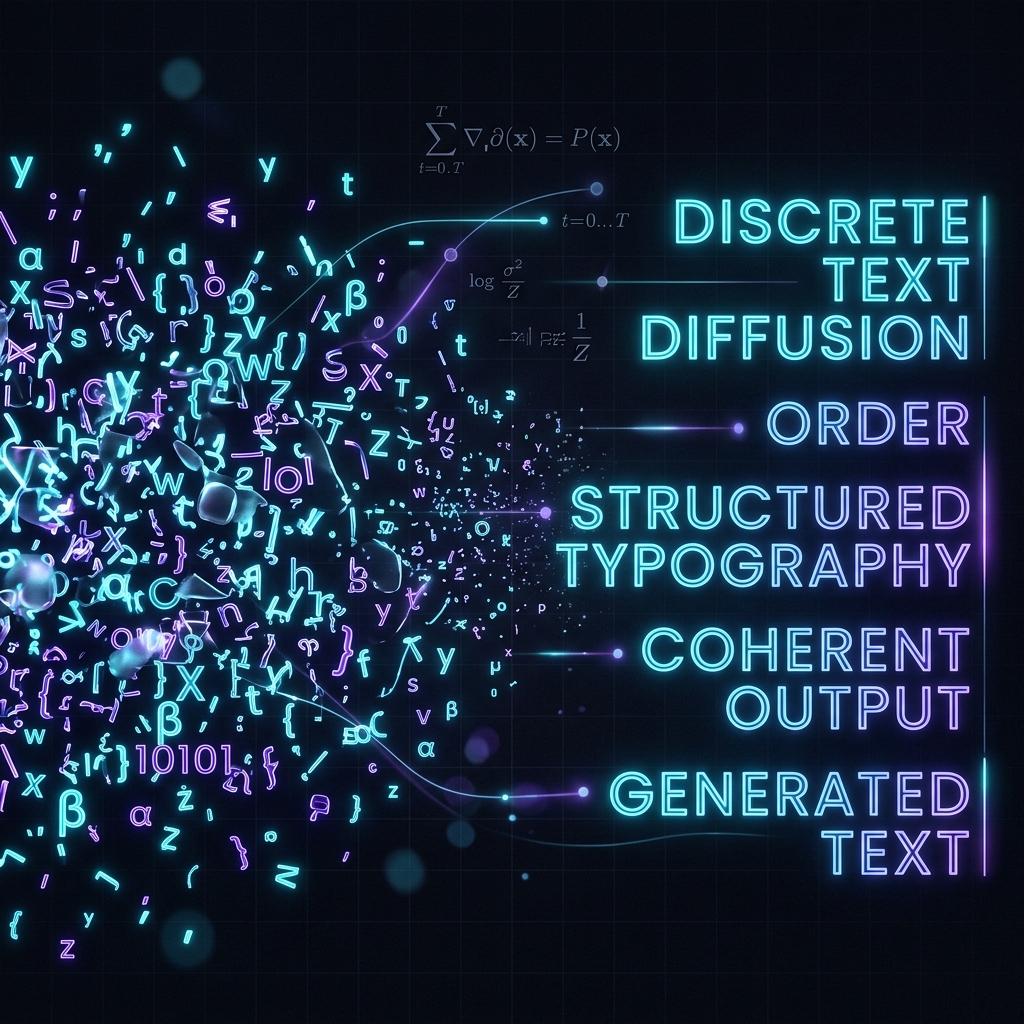
In contrast, discrete text diffusion treats text generation not as a sequence of predictions, but as a continuous denoising process over a multi-dimensional canvas of tokens. By iteratively refining all token positions simultaneously, diffusion language models change the core paradigm of machine reading and writing.
Understanding DiffusionGemma
Released by Google DeepMind in June 2026, DiffusionGemma represents the first open-weights implementation of discrete text diffusion mapped to a large, production-grade model. Built on top of the Gemma 4 model family, DiffusionGemma utilizes a 26B Mixture-of-Experts (MoE) architecture, dynamically activating approximately 3.8B active parameters per token prediction step.
DiffusionGemma differs fundamentally from previous experimental diffusion models by moving away from continuous-space embedding diffusion (which maps tokens to high-dimensional vectors and adds Gaussian noise). Instead, it operates directly on discrete token state spaces using a specialized absorbing-state masking framework.
Key Architectural Elements of DiffusionGemma
- Absorbing-State Canvas: Rather than predicting tokens from left-to-right, the model begins with a canvas completely filled with `[MASK]` tokens. Over a sequence of steps $T$ (typically $32 \le T \le 64$), it reveals and refines the tokens at all positions simultaneously.
- Bidirectional/Non-Causal Attention: Standard autoregressive models use causal masking to restrict attention to previous tokens. DiffusionGemma removes this barrier, employing full bidirectional self-attention at every denoising step, allowing tokens to reference both future and past contexts.
- Compute-Bound Execution: In standard inference, LLMs read and write huge KV-caches from memory, making execution memory-bandwidth bound. DiffusionGemma decodes all tokens concurrently, allowing it to saturate execution pipelines and remain compute-bound, achieving superior performance on consumer hardware like NVIDIA RTX 4090s.
Turning Autoregressive Models into Diffusion Engines
Transforming a pre-trained autoregressive model (such as DeepSeek-V4-Flash-Pro or GLM-5.2) into a discrete diffusion model is an elegant way to transfer linguistic knowledge and world facts without training from scratch. The conversion process consists of several phases:
1. The Weight Transplantation Phase
Autoregressive models contain valuable weights representing token embeddings, multi-head self-attentions (Q, K, V, O projections), and Feed-Forward Networks (FFNs or MoE experts). These weights can be mapped directly into the diffusion student architecture.
2. Removing the Causal Attention Mask
To enable bidirectional context, the causal triangular attention mask must be removed. In a standard Transformer, attention is computed as:
Where $M_{ij} = -\infty$ for $j > i$ (causal mask). In the diffusion version, we set $M_{ij} = 0$ for all token positions, enabling full attention across the entire sequence.
The Attention Gap Challenge
Because the base autoregressive model was trained only on left-to-right contexts, the attention projections (particularly query/key mappings) are unaccustomed to attending to subsequent tokens. Initializing a model with bidirectional attention without fine-tuning will lead to immediate degradation of output distributions. To fix this, we apply a short, high-efficiency alignment training phase.
3. The Absorb-State Alignment Recipe
Introduce a special `[MASK]` token (which can be initialized as a copy of the existing pad or unknown token embeddings). During the initial alignment phase, we randomly mask out percentages of the input sequence:
where $p \sim \text{Uniform}(0.1, 0.9)$. The model is trained to reconstruct the original tokens $x$ at masked positions while maintaining its original representation weights for unmasked positions, allowing the model to smoothly bridge the transition from causal autoregression to bidirectional denoising.
Throughput & Latency Economics: The B300 NVL72 Rack Analysis
To understand the commercial viability of diffusion models versus autoregressive models, we analyze their deployment economics at scale. Specifically, we compare a custom fine-tuned **Gemma-4-31B** (Autoregressive) against **DiffusionGemma (26B MoE)** and **DeepSeek-V4-Flash** (MoE) on an NVIDIA B300 NVL72 rack (providing up to 1.4 ExaFLOPS FP4 compute).
Understanding the Bottlenecks
In a standard autoregressive model, the execution profile is split into two phases: the **Prefill phase** (compute-bound, processing the prompt) and the **Decoding phase** (memory-bandwidth bound, generating tokens one-by-one). Because decoding requires reading the entire model weights and the growing KV-cache from memory for every single token, the hardware sits idle waiting for memory transfers, severely limiting maximum batch size.
In contrast, a discrete diffusion model generates blocks of tokens (e.g. 512 tokens) in parallel. It runs $T$ steps of full compute-bound forward passes. There is no KV-cache accumulating token-by-token. This elevates the **arithmetic intensity** (FLOPs per byte transferred), enabling the hardware to operate at maximum efficiency.
| Metric | Gemma-4-31B (Autoregressive) | DiffusionGemma (26B MoE, 3.8B Active) | DeepSeek-V4-Flash (MoE with DSpark) |
|---|---|---|---|
| Generation Paradigm | Sequential (Token-by-Token) | Parallel Canvas Denoising | Sequential (Token-by-Token) |
| KV-Cache Size per User | High (Scales linearly with context) | Zero (No sequential caching) | Medium (Optimized via MLA) |
| Max Batch Size (NVL72 Rack) | ~1,024 concurrent requests | ~8,192 concurrent requests | ~2,048 concurrent requests |
| Individual Latency (1 token) | ~12 ms (Speculative Decoding) | ~80 ms (Requires $T=32$ steps) | ~10 ms (Super fast Flash core) |
| Max Throughput (Total tok/sec) | ~45,000 tokens/sec | ~195,000 tokens/sec | ~120,000 tokens/sec |
The Speculative Integration
While individual token latency is higher in diffusion models because they must run $T$ full forward passes to output the first block, their **total system throughput** under heavy batching is up to 4.3x higher. This makes diffusion models exceptionally cost-effective for offline batch workloads, document parsing, agentic tool workflows, and design generation where high volume and low cost are prioritized over immediate user-typing latency.
The Mathematical Guide to Discrete Diffusion & MoEs
To build or convert these models, one must command the underlying mathematical structures. Here is the formal formulation of discrete denoising diffusion probabilistic models (D3PM) and masked diffusion language models (MDLM), followed by Mixture-of-Experts routing.
1. The Forward Process Transition Matrix
Let $x_t$ be a categorical variable taking values in a vocabulary of size $K$. We define the forward corruption process as a Markov chain where transitions are governed by a transition matrix $\mathbf{Q}_t \in \mathbb{R}^{K \times K}$:
where $\mathbf{v}(x)$ is a one-hot column vector of length $K$. The state transition at step $t$ starting from the clean data $x_0$ can be computed in closed form:
2. Absorbing-State Diffusion (MDLM)
In a masked text diffusion model like MDLM, the transition matrix $\mathbf{Q}_t$ is structured such that a token either remains unchanged or transitions into an absorbing `[MASK]` state (represented as state $K$). It can never transition out of the `[MASK]` state in the forward process.
Here, $\alpha_t \in [0, 1]$ controls the rate of corruption. As $t \to T$, $\bar{\alpha}_t \to 0$, ensuring the entire sequence eventually collapses into the absorbing `[MASK]` state.
3. The Reverse Process & Loss Function
The model parameterized by $\theta$ learns to predict the posterior distribution of the original clean token $x_0$ given the corrupted token $x_t$ at all positions: $p_\theta(\hat{x}_0 \mid x_t)$. The objective function is a variational bound on the log-likelihood:
For absorbing-state diffusion, the posterior $q(x_{t-1} \mid x_t, x_0)$ is simple: if $x_t$ is not masked, $x_{t-1}$ must be identical to $x_t$. If $x_t$ is masked, $x_{t-1}$ could either be the true token $x_0$ or remain masked. The model simply minimizes the cross-entropy loss at masked token positions:

4. Mixture-of-Experts (MoE) in Diffusion
Mixture-of-Experts layers replace dense Feed-Forward Networks with $N$ independent expert networks $\{E_1, E_2, \dots, E_N\}$. For a given token representation $h$, a gating network $G(h)$ computes routing coefficients:
Where $G(h) = \text{Softmax}(\text{TopK}(h W_{\text{gate}}, k))$. To ensure that experts are utilized evenly during training, we introduce a auxiliary load-balancing loss:
where $f_i$ is the fraction of tokens routed to expert $i$, and $P_i$ is the average probability assigned to expert $i$ by the gating network.
The Diffusion MoE Dynamics: During early denoising steps ($t \approx T$), the input canvas is highly chaotic and contains mostly `[MASK]` tokens. The gating routing profiles default to generic semantic representation mapping. As the canvas is resolved ($t \to 0$), routing profiles dynamically shift to specialized linguistic and factual experts, optimizing parameters for specific domains.
Low-Cost Text Diffusion: Distilling Autoregressive Giants
Training a text diffusion model from scratch requires substantial compute. However, you can build a fast, high-quality diffusion model under a **10,000 USD compute budget** by distilling knowledge directly from a larger autoregressive model (like Qwen-3.6-72B).
The Distillation Pipeline
- Weight Initialization: Initialize the student diffusion network weights using the first $L$ layers of the pre-trained autoregressive model. This inherits strong attention and FFN representations.
- Logit Matching: Pass clean sequences $x$ through the teacher autoregressive model to extract target logits $\mathbf{z}_{\text{teacher}}$ at all positions.
- Masked Forward Passes: Construct corrupted inputs $\tilde{x}$ by replacing random subsets of tokens with `[MASK]`. Pass $\tilde{x}$ through the student.
- Objective: Minimize the Kullback-Leibler (KL) divergence between the student's output probability distributions and the teacher's target distributions at the masked positions:
where $T$ is the temperature parameter, and $\lambda$ controls the balance between ground-truth reconstruction and teacher mimicking. This alignment convergence is extremely rapid, requiring less than 50M tokens of training to reach high fidelity.
Design, Taste, and Agentic Architectures
Most modern open-weights models are trained on raw web crawls, leading to standard, uninspired outputs. They lack taste — the ability to evaluate design layout, typography, proportions, and artistic composition. When used inside coding agents, they default to bloated, generic solutions.
To build a high-taste system (like the Yantra platform), we must align models on specialized datasets containing curated UI/UX architectures, premium CSS implementations, and evidence-first design systems.
Dense vs. MoE Models for Design Tasks
For design tasks, **Dense models** (like a custom fine-tuned Qwen-3.6-27B) often exhibit more consistent stylistic coherence than standard MoE models (like DeepSeek-V4-Flash). Because MoEs route tokens to disparate experts dynamically, they can introduce microscopic stylistic inconsistencies across a large UI layout. A dense model maintains a single, unified representation path, resulting in more coherent visual layouts and consistent design decisions.
How Ornith Models Work
Developed by DeepReinforce, **Ornith** models achieve state-of-the-art agentic performance by bypassing fixed human harnesses. Instead of standard pipelines, Ornith uses **Self-Scaffolding**:
During training under reinforcement learning, the model is penalized or rewarded based on the success of its generated code. Crucially, it also learns to generate the **scaffolding harness** — the orchestration scripts, the testing verification layers, and the tool configs — needed to validate its own code. It learns to construct its own tools dynamically rather than relying on human-written wrappers.
The Yantra Vision: Node-Based Super App
The ultimate goal of the Yantra ecosystem is a Rust-based desktop environment where the agent doesn't write raw, fragile code. Instead, the agent interacts with **high-taste structural nodes and configuration graphs**:
- The agent defines user interfaces by composing structured visual nodes.
- Workflows are orchestrated via state-machine configs, not custom scripts.
- The underlying Rust runtime guarantees memory safety, sandboxed execution, and instant reloading.
By restricting the agent's action space to premium, high-taste components and semantic configs, we prevent the agent from producing legacy code, resulting in an environment that is clean, secure, and visually stunning.